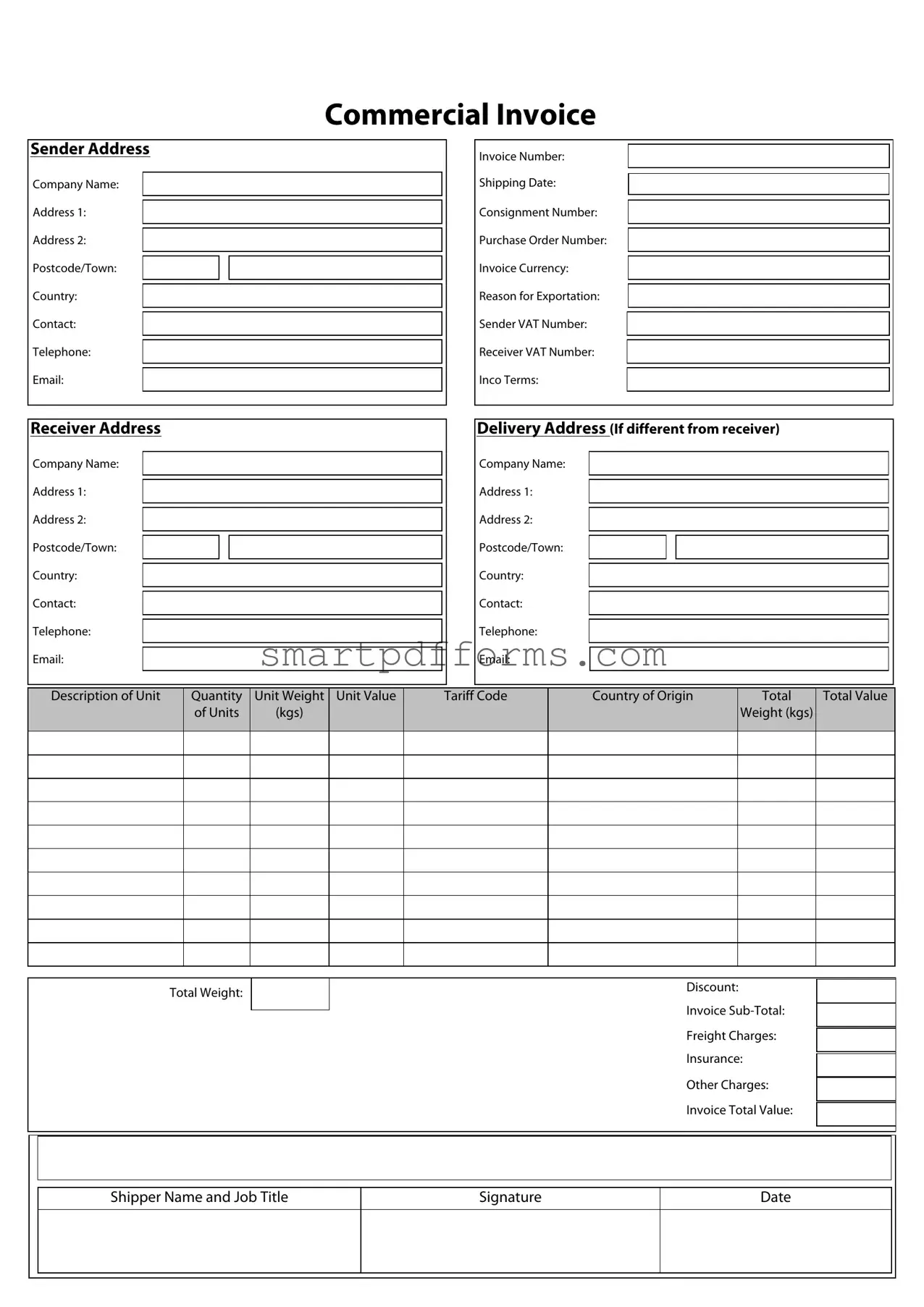
Blank Commercial Invoice PDF Template
When it comes to international trade, the Commercial Invoice form plays an indispensable role, serving as a critical document for both the sender and receiver of goods across borders. This comprehensive form not only details the sender and receiver’s contact information and addresses but also includes specific data like the invoice number, shipping date, and consignment number, essential for tracking and accounting purposes. Furthermore, it outlines the purchase order number, making it easier to reconcile transactions. The form goes a step further by listing the invoice currency and reason for exportation, alongside VAT numbers for both the sender and receiver, which are crucial for tax and customs purposes. Additionally, it elaborates on the delivery terms (Inco Terms), making the responsibilities of involved parties clear. For instances where the delivery address differs from the receiver's, this form accommodates that information, ensuring goods are accurately directed. The heart of the form lies in the detailed description of the goods being shipped, including unit quantities, weights, values, tariff codes, and the country of origin. This meticulous breakdown is crucial for customs clearance and determining the total weight and value of the shipment. Discounts, if any, are applied before calculating the invoice sub-total, which is then adjusted for freight, insurance, and other charges to arrive at the invoice total value. The document is rounded off with the shipper’s signature, affirming the authenticity and accuracy of the information provided. This form not only facilitates the smooth operation of global trade by ensuring that all parties have a clear understanding of the transaction details but also adheres to regulatory compliance, making it a vital instrument in the international commerce toolkit.
Preview - Commercial Invoice Form

Commercial Invoice
Sender Address
Company Name:
Address 1:
Address 2:
Postcode/Town:
Country:
Contact:
Telephone:
Email:
Invoice Number:
Shipping Date:
Consignment Number:
Purchase Order Number:
Invoice Currency:
Reason for Exportation:
Sender VAT Number:
Receiver VAT Number:
Inco Terms:
Receiver Address
Company Name:
Address 1:
Address 2:
Postcode/Town:
Country:
Contact:
Telephone:
Email:
Delivery Address (If different from receiver)
Company Name:
Address 1:
Address 2:
Postcode/Town:
Country:
Contact:
Telephone:
Email:
Description of Unit
Quantity
of Units
Unit Weight Unit Value (kgs)
Tariff Code
Country of Origin
Total
Weight (kgs)
Total Value
Total Weight:
Discount:
Invoice
Freight Charges:
Insurance:
Other Charges:
Invoice Total Value:
Shipper Name and Job Title
Signature
Date
Form Data
| Fact Name | Description |
|---|---|
| Purpose of Commercial Invoice | Facilitates international trade by providing a detailed record of the transaction between exporter and importer, listing goods shipped and terms of sale. |
| Essential Elements | Includes critical details such as sender and receiver addresses, company names, contact information, invoice and consignment numbers, and a detailed description of goods. |
| Legal and Tax Relevance | Crucial for customs declarations and determining duties and taxes. It must include sender and receiver VAT numbers for tax purposes. |
| Variability by Jurisdiction | Laws governing the form and content of the Commercial Invoice can vary by country, influencing specific requirements like layout and additional declarations. |
| Role in Logistics | Used by carriers and logistic service providers to verify the shipment's details, including total weight and value, facilitating proper handling and delivery. |
Instructions on Utilizing Commercial Invoice
When it comes to exporting goods, a Commercial Invoice plays a critical role. This document serves not only as a bill for the goods sold but also provides essential information needed for customs clearance. Ensuring that each part of the invoice is completed accurately is crucial to avoid delays or complications during the shipping process. Below are step-by-step instructions that will guide you through filling out a Commercial Invoice form.
- Sender Address:
- Enter the Company Name.
- Fill in Address 1 and Address 2 with the appropriate details.
- Type in the Postcode/Town and Country.
- Provide a point of Contact, along with their Telephone number and Email address.
- Invoice Details:
- Assign an Invoice Number.
- Specify the Shipping Date.
- Input the Consignment Number and Purchase Order Number, if applicable.
- Select the Invoice Currency.
- Describe the Reason for Exportation.
- Enter the Sender VAT Number and Receiver VAT Number, where necessary.
- Choose the applicable Inco Terms.
- Receiver Address:
- Fill in the Company Name.
- Provide Address 1 and Address 2.
- Enter the Postcode/Town and Country.
- Include a point of Contact, their Telephone number, and Email address.
- If the Delivery Address is different from the receiver's, repeat step 3 with the new details.
- Description of Goods:
- For each type of item being shipped, specify the Description of Unit, Quantity of Units, Unit Weight (in kilograms), Unit Value, Tariff Code, and Country of Origin.
- Calculate and record the Total Weight (in kilograms) and Total Value of the consignment.
- Additional Costs:
- Enter any Discount offered.
- Detail the Invoice Sub-Total.
- Itemize additional charges such as Freight Charges, Insurance, and Other Charges.
- Calculate the Invoice Total Value.
- At the bottom, the Shipper must include their Name and Job Title, provide a Signature, and date the form.
Properly filling out the Commercial Invoice is key to a smooth export process. It's essential to double-check each part of the form for accuracy and completeness. This document not only acts as a record of the sale but also ensures that all legal and logistics requirements are met for international shipping. Being meticulous at this stage can save time and prevent potential issues with customs or delivery delays.
Obtain Answers on Commercial Invoice
What is a Commercial Invoice?
A Commercial Invoice is a crucial document used in international trade. It provides information about the products being shipped, including their value, quantity, and description. This invoice serves as a customs declaration and is required by customs for the assessment of duties and taxes.
Why is the sender and receiver's VAT number important on a Commercial Invoice?
The sender and receiver's VAT number are important for tax purposes. They help in identifying the parties involved in the trade and are necessary for processing VAT charges, especially in transactions within the European Union, where VAT plays a significant role in the cost of goods and services.
Can the delivery address be different from the receiver address?
Yes, the delivery address can be different from the receiver's address. This flexibility is crucial when the goods are being shipped directly to a third party or a different location as specified by the buyer or receiver of the goods.
What are Inco Terms, and why are they included in the Commercial Invoice?
Inco Terms, short for International Commercial Terms, are a set of predefined commercial terms published by the International Chamber of Commerce (ICC). They are included in the Commercial Invoice to clearly define the responsibilities of sellers and buyers regarding the delivery of goods, including transportation costs, insurance, and customs clearance. It helps in preventing misunderstandings and disputes in international trade.
How is the 'Total Weight' calculated on the Commercial Invoice?
The 'Total Weight' on the Commercial Invoice is calculated by summing up the weights of all the units shipped. This figure is important for logistics purposes, including shipping costs and customs clearance.
What does the 'Total Value' represent on the Commercial Invoice?
The 'Total Value' on the Commercial Invoice represents the total monetary value of the goods being shipped. This amount is used by customs to assess duties and taxes and must accurately reflect the value of the goods.
What is the purpose of including freight, insurance, and other charges on the Commercial Invoice?
Freight, insurance, and other charges are included on the Commercial Invoice to provide a comprehensive overview of the total cost associated with shipping the goods. These details are necessary for both the buyer and customs authorities to understand the full value of the consignment, ensuring proper taxation and compliance with international trade regulations.
Is a signature required on the Commercial Invoice?
Yes, a signature is required on the Commercial Invoice. The signature, typically from the shipper or an authorized representative, certifies the accuracy of the information provided. It’s a declaration that the details are correct and in compliance with customs regulations, serving as a formal agreement between the shipper and the receiver.
How is the 'Invoice Number' used in tracking shipments?
The 'Invoice Number' is a unique identifier for the shipment and is used for tracking and reference purposes. It helps in tracking the shipment through customs and delivery, providing a straightforward way to reference specific transactions in case of inquiries, returns, or disputes.
Common mistakes
When completing a Commercial Invoice form, several common mistakes can impact the process negatively. Recognizing and avoiding these errors can streamline customs clearance and ensure accurate billing and record-keeping. The mistakes often made include:
- Omitting or inaccurately filling out sender and receiver addresses, including the postcode, town, and country, which can lead to delays in shipment.
- Incorrectly listing the Invoice Number, Shipping Date, and Consignment Number, which are crucial for tracking and referencing shipments.
- Failing to specify the correct Invoice Currency and Reason for Exportation, leading to potential confusion over payment and compliance with export regulations.
- Neglecting to include or incorrectly stating Sender VAT Number and Receiver VAT Number, which are essential for tax purposes and customs clearance.
- Incorrectly choosing or leaving blank the Inco Terms, which define the shipment terms between buyer and seller and affect responsibilities and costs.
- Forgetting to fill in or providing wrong information in the Delivery Address section when it differs from the receiver's address, causing possible delivery mishaps.
- Errors in the description of goods, such as incorrect Quantity of Units, Unit Value, or Tariff Code, may result in incorrect duty charges or customs clearance issues.
- Not accurately calculating the Total Weight, Total Value, and other financial details such as discounts, freight charges, and insurance, which can affect the total cost and value declared on the invoice.
- Failing to sign and date the invoice by the Shipper Name and Job Title section, thereby questioning the invoice's authenticity and potentially delaying shipment.
It's critical to review each section of the Commercial Invoice form thoroughly before submission to ensure all information is complete, accurate, and clearly stated. This can prevent unnecessary delays, fees, and complications during the shipping process.
Documents used along the form
When conducting international trade, the Commercial Invoice plays a pivotal role in detailing transaction specifics, from product descriptions to terms of sale. Yet, this document rarely travels alone. A suite of complementary forms and documents are often required to ensure compliance, facilitate customs clearance, and support logistical processes. Here's a look at some of these key documents that typically accompany a Commercial Invoice.
- Bill of Lading: Acts as a contract between the owner of the goods and the carrier. It also serves as a receipt for shipped merchandise and can be used to claim the delivery of the goods.
- Packing List: Provides detailed information on the quantity, description, and type of goods being shipped. It is used by customs to verify cargo, by buyers to confirm receipt, and by logistics to manage inventory.
- Certificate of Origin: A document that certifies the country in which the goods were manufactured. It is crucial for customs to determine whether the goods are eligible for import, or subject to duties.
- Shipper’s Export Declaration (SED): Required by the U.S. Census Bureau for tracking export statistics, the SED documents detailed information about the export transaction.
- Insurance Certificate: This document provides information on the insurance coverage of the exported goods, offering protection against loss, damage, or theft during transit.
- Export License: Some goods require permission from the relevant government body before being exported. The export license serves as this permission.
- Import License: Similar to the export license, some goods may require a license to be imported into the destination country, dictated by its laws and regulations.
- Consular Invoice: Required by some countries, it is used for customs clearance and must be validated by the consulate of the destination country.
- Inspection Certification: An official document, often issued by a third party, that certifies the goods have been inspected and meet the quality standards or contract specifications.
- Pro Forma Invoice: An initial bill of sale sent to buyers in advance of a shipment or delivery of goods. It typically describes the purchased items and other details such as cost, delivery terms, and weight.
Each document serves its purpose, whether to comply with import-export regulations, assure parties of the goods' condition and origin, or clarify the specifics of the trade agreement. Together, these documents create a transparent, efficient, and secure process for international trade transactions, alleviating potential hurdles and ensuring a smooth passage through customs. Understanding the importance and function of each can greatly simplify the complexities involved in global trade.
Similar forms
Proforma Invoice: Similar to a commercial invoice, a proforma invoice outlines the products or services sold and the amount due, but is used as a preliminary bill of sale prior to shipment or delivery of goods. It serves as a negotiator between buyer and seller without being a final invoice.
Packing List: Though more focused on the contents of a shipment than financial details, a packing list complements a commercial invoice by providing detailed information on the quantity, description, and type of goods shipped, alongside their weight and packaging details.
Bill of Lading: This document is a contract between the owner of the goods and the carrier stating the details of the goods transported. Like a commercial invoice, it includes information about the shipper, receiver, and goods shipped, but it also serves as a receipt issued by the carrier once the goods are shipped.
Purchase Order: A purchase order is a document sent from a buyer to a seller authorizing the purchase of products or services. It precedes the commercial invoice in the buying process, detailing the types, quantities, and agreed prices for products or services.
Sales Contract: This agreement details the terms of a sale of goods between two parties. It shares similarities with the commercial invoice by detailing product or service descriptions, quantities, and agreed prices, but it is more comprehensive in covering the terms and conditions of the sale.
Quotation: A quotation is an offer by a supplier to sell goods or services at a specified price, under specified conditions. It resembles a commercial invoice in layout and content but serves as an invitation to make a purchase rather than a request for payment.
Credit Note: A document issued to correct errors on a commercial invoice or to credit the purchaser the value of returned items. It mirrors the invoice in format, referencing similar information but indicating amounts being credited rather than charged.
Export Declaration: This document is necessary for international shipments. It provides authorities with details of the goods being exported, much like the commercial invoice lists the specifics of the goods being sold and shipped, including their value and description.
Receipt: A receipt is proof of payment for goods or services received. While primarily a simple document confirming the transaction, it shares the aspect of proving an exchange of value like a commercial invoice, specifying details of the purchase.
Dos and Don'ts
When filling out a Commercial Invoice for international trade, attention to detail and accuracy are paramount. This document is essential for customs clearance and ensures that your goods move smoothly across borders. Below are five crucial do's and don’ts to consider while completing the Commercial Invoice form:
- Do double-check the sender and receiver's information, including full addresses, VAT numbers, and contact details, to prevent any delays in shipment due to incorrect or incomplete information.
- Do provide a detailed description of the goods being shipped, including the quantity, unit value, total value, and tariff code. This ensures that customs authorities have a clear understanding of the contents and can accurately assess duties and taxes.
- Do accurately list the Incoterms, as they define the shipment terms and responsibilities between the seller and buyer. This clarity is essential for avoiding disputes and ensuring a smooth delivery process.
- Do include the total weight and dimensions of the shipment. This is crucial for shipping companies to determine shipping costs and for customs clearance.
- Do sign and date the invoice. A signature is necessary to validate the information on the invoice, making it a legally binding document.
- Don’t leave out the Invoice Number, Shipping Date, and Consignment Number. These references are critical for tracking the shipment and resolving any issues that may arise during the shipping process.
- Don’t underestimate the importance of filling out the “Reason for Exportation”. This section helps customs authorities understand the context of the shipment, which can impact the applicable duties and taxes.
- Don’t neglect to specify the Invoice Currency. Failure to do so can lead to confusion or incorrect valuation by customs, affecting the duties and taxes imposed.
- Don’t forget to include any discounts, freight charges, insurance, and other charges in the invoice sub-total. These elements are crucial for accurately representing the total invoice value.
- Don’t use vague or inaccurate descriptions of the goods. This can lead to delays in customs, additional inspections, or even penalties.
Adhering to these guidelines will help ensure that your commercial invoices are completed correctly, facilitating a smoother process through customs and preventing unnecessary delays or costs. Always remember the significance of this document within international trade and the role it plays in the successful delivery of goods across borders.
Misconceptions
When it comes to international trade, the commercial invoice is a critical document. However, there are several common misconceptions about this form. Let's debunk some of these myths to ensure a clearer understanding of its purpose and requirements.
- Only Goods Value Matters:
Many believe the commercial invoice is just a declaration of the goods' value. In reality, it serves a broader purpose, including a detailed description of the goods, the terms of sale, and information necessary for customs clearance.
- It's Identical to a Shipping Invoice:
Though similar, the commercial invoice and shipping invoice serve different purposes. The commercial invoice is primarily used for customs declaration, while the shipping invoice relates to the shipping charges and details.
- No Need for Detailed Goods Description:
Contrary to this belief, a detailed description of the goods, including the tariff code and country of origin, is crucial for customs authorities to assess duties and taxes correctly.
- Any Currency Can Be Used:
While it might seem convenient, invoices should be issued in the currency agreed upon in the sales contract. This helps avoid confusion and ensures consistency with other documentation.
- Sender and Receiver VAT Numbers Are Optional:
For transactions within VAT-implementing countries, providing VAT numbers of both the sender and receiver is mandatory for tax purposes.
- IncoTerms Are Not Necessary:
IncoTerms, or International Commercial Terms, clarify the shipment's delivery specifics, risk, and cost responsibilities. Omitting these can lead to disputes and confusion over shipment terms.
- A Signature Isn't Required:
A common oversight is dismissing the need for a signature. The shipper's name, job title, and signature authenticate the document and may be required for legal and customs verification.
- Insurance and Other Charges Are Optional Details:
Detailing insurance and other charges on the invoice contributes to the total value declaration for customs. It's vital for an accurate assessment of duties and taxes.
- One Copy Is Enough:
Multiple copies of the commercial invoice may be needed for the shipper, receiver, and customs authorities. Ensuring sufficient copies can facilitate smoother processing through customs.
Understanding the commercial invoice's complexity and its role in international trade minimizes the risk of delays and additional charges. Ensuring accuracy and completeness in its preparation is key to a hassle-free customs clearance process.
Key takeaways
Here are key takeaways to consider when filling out and using a Commercial Invoice form:
- Ensure that all addresses (sender, receiver, and delivery if different from receiver) are complete and accurate to avoid delays or confusion in the shipping process.
- Invoice number, shipping date, and consignment number are crucial for tracking and reference purposes; make sure these are clearly mentioned and match any related shipping documents.
- Accurately detail the description of goods, including quantity, unit weight, unit value, and tariff code. This information is essential for customs and valuation purposes.
- The reason for exportation, along with sender and receiver VAT numbers, must be specified to comply with tax regulations in both the exporting and importing countries.
- Inco Terms should be clearly defined to outline the delivery terms, risk, and cost responsibilities between the seller and the buyer, minimizing disputes.
- Remember to include the total weight and total value of the shipment, as well as any applicable discounts, freight charges, insurance, and other charges to precisely calculate the invoice total value.
- The invoice currency should be specified to avoid confusion during payment processing and to ensure compliance with international trade regulations.
- A signed and dated invoice by the shipper is often required to verify the authenticity of the document and the agreement to the stated terms.
Proper completion and accurate information on the Commercial Invoice form facilitate smoother customs clearance and help ensure that the goods are delivered in a timely manner.
Popular PDF Forms
Ohio Repossession Laws - Guides the user through the process of legally authorizing a third party to retrieve a vehicle, ensuring all necessary legal steps are followed.
City of Plantation Building Department Forms - It offers guidance on how to comply with inspection requirements as per the Florida Building Code, ensuring safety and regulation compliance.